Schools’ operational funding nearly 12% below inflation
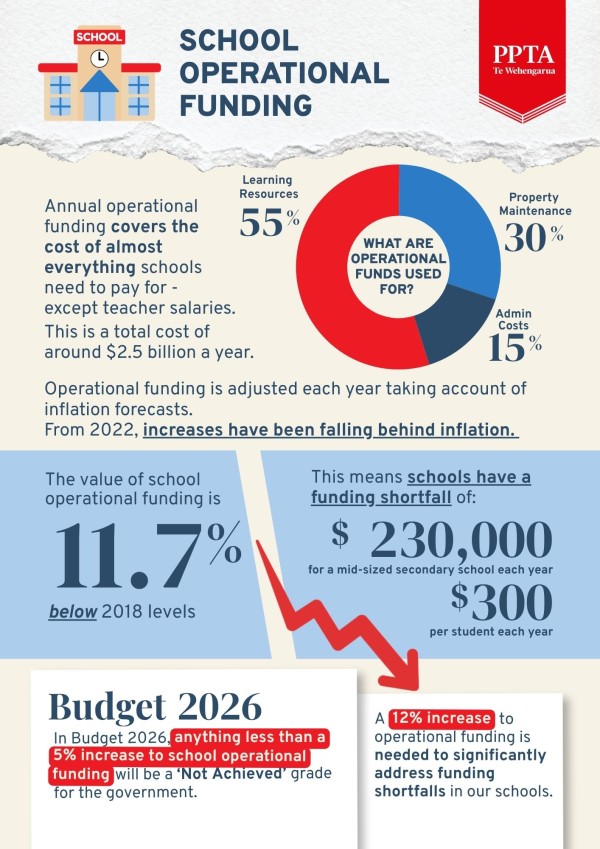
A gap has emerged over the last five years between the rate of inflation and the funding that schools get for their learning resources, administration and routine building maintenance. And the gap has grown to almost 12 percent.

A report prepared by PPTA Te Wehengarua shows that between 2011 and 2021, increases to operational grants kept pace with inflation. However, since 2022 increases have fallen well behind inflation.
For example, a middle-sized secondary school with a roll of about 800 students would have received an operational grant of around $1.8 million in 2021 and spent that on a range of goods and services that advance teaching, learning, student wellbeing and school maintenance.
By 2026, the school’s operational grant would have increased by about $220K. However, based on the current inflation rate, the costs of those goods and services would have increased by about $450K - nearly twice as much. So, this school would be worse off by about $230K.
“The findings of this report will resonate for schools around the motu,” says Steve McCracken, chairperson of the Secondary Principals’ Council. “If school leaders have been wondering why it feels increasingly difficult to make ends meet and you’re having to do more with less, this explains why.
“A gap of almost 12 percent is very significant. Schools can only imagine what they could do if their operational funding was keeping pace with inflation.”
Chris Abercrombie, PPTA Te Wehengarua president, says schools’ operational grants are used for all the things that help make a school tick - all of the non-teaching staff, the resources, the fuel for the school van, the sports uniforms, the materials for the science labs.
“All of this makes a world of difference to young people’s education.”
Inflation for the 2026 calendar year stands to make the situation even harder for schools, which will in turn impact upon students. Budget Day forecasts are likely to be around 3%, with a serious risk that actual inflation will come in much higher due to the fuel crisis.
The report calls for an urgent adjustment to this year’s operational grant and states that if the increase to the 2027 operations grant in next week’s Budget is below 3%, the Government would be knowingly making the shortfall worse. An increase of between 3% to 5% would fail to address the shortfall, while an increase from above 5% to 12% would make some progress. Any increase above 12% would significantly tackle the shortfall.
“Schools will be watching this figure very closely next Thursday.”
Michael Waller, chairperson of the Rural Education Reference Group, says while a $300 shortfall per student is devastating for any school, the reality is even starker for rural institutions where fixed operational costs like property maintenance, heating, transportation and even fuel, absorb a far higher proportion of our budgets.
“Rural schools cannot rely on the same alternative revenue streams or economies of scale that urban schools might access. When operational grants fail to keep pace with inflation, rural boards are forced into impossible situations often choosing between maintaining basic infrastructure or cutting vital subjects, resources, and support staff.
“The rural education sector is holding itself together right now purely on raw goodwill and the dedication of some of the most exhausted teachers and support staff I have ever seen.
“We strongly echo the call for Budget 2026 to not only match current inflation but to actively introduce catch-up funding. Without urgent intervention and real respect for our rural educators, the educational inequities facing our students will only continue to widen.”
Last modified on Friday, 22 May 2026 01:22